
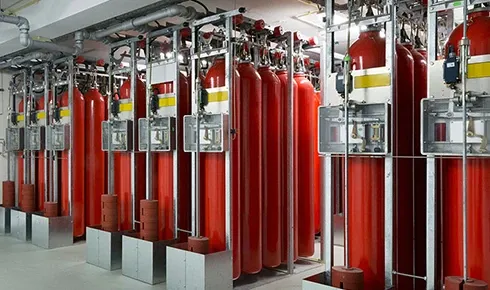
CO2 Fire Suppression Systems
Rapid Response to Fire
Gaseous fire suppression systems come to the fore as the fastest and most effective method among all fire suppression systems, in activation time, intervention in the fire event and bringing the fire to an end.
These systems are typically used in volumes that house critical equipment or hold sensitive commodities. Because of their rapid response and precise suppression, process downtime and fire damage are kept to a minimum.
Certificates & Approvals of the Gaseous Suppression Systems We Offer


System Components
In gaseous suppression systems, the extinguishing agent is generally kept in liquid or liquid-gas mixture form under high pressure. Where water-based systems rely on a fire pump to deliver water to the space, gaseous systems carry the extinguishing chemical (gas) to the space using nitrogen or the pressurised gas itself. With systems that protect a single volume and alternative solutions that can protect several spaces from one point, gaseous suppression systems give designers wide flexibility.

Extinguishing Chemicals
Carbon dioxide is filled in solid, liquid and gas form.
Steel Cylinders
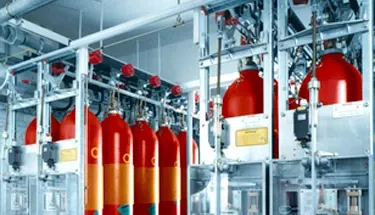
Stored in steel drawn cylinders or tanks, in the 60 bar or low-pressure class.
Piping & Hangers
ANSI SCH40-80 drawn steel pipes and forged steel fittings carry the agent to the protected space.

Extinguisher Panel
Systems are triggered by detectors. A notification system is set up with a button, flasher and siren.

Nozzles
Nozzles are placed in the room as open-ended, and also under the suspended ceiling and flooring, if any.

Valves
The cylinder valve is actuated electrically or pneumatically. The valve prevents turbulent flow.
CO2 Suppression Systems
In CO2 fire suppression systems, the cooling property of carbon dioxide gas is used. As well as protecting a closed volume, CO2 systems offer a local-protection option that clean agent suppression systems do not: a specific point on a production machine can be protected, as can equipment that sits outside a closed environment, such as transformers and turbines. CO2 systems are prepared in accordance with the NFPA 12 standard. The CO2 extinguishing agent can be stored in steel cylinders in mixed, three-phase (gas-liquid-solid) form at around 60 bar; a low-pressure alternative — held in horizontal cylindrical tanks — is also available for protecting multiple or very large volumes.
- Generators
- Transformers
- Cable Galleries
- Paint Shops
- Offers an Economical Solution
- Low Filling Cost
- No Space Sealing Required
- Design and Calculation Flexibility
Related Solutions
Let's Identify the Risks in Your Process
Let's determine together what precautions should be taken regarding explosion and fire safety in your facility.
