
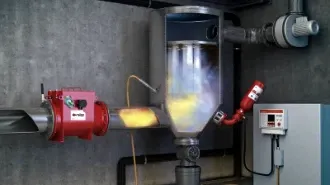
Explosion Prevention Systems
Dust Explosion Safety
Powders or powder-like substances are processed in many industries or are by-products of the manufacturing process. Whether the powder is useful (for example, for the manufacture of synthetics, pigments or pharmaceuticals) or waste, the vast majority of dust-like substances pose a fire and explosion hazard. Eighty percent of all industrial dust is flammable, and even a 1mm layer of dust in a closed room is enough to trigger an explosion when the dust swirls and ignites. These facts, combined with the fact that those affected are not sufficiently aware of the danger (as opposed to the danger of gas explosions) highlight the importance of preventing dust explosions.
When ignition occurs, the pressure of the flash will force the structural integrity of the enclosed volume and spread to connected ducts and equipment, causing even greater damage. A variety of explosion protection methods are used to quickly and reliably depressurize or relieve the enclosed space and protect the inlet and outlet equipment.
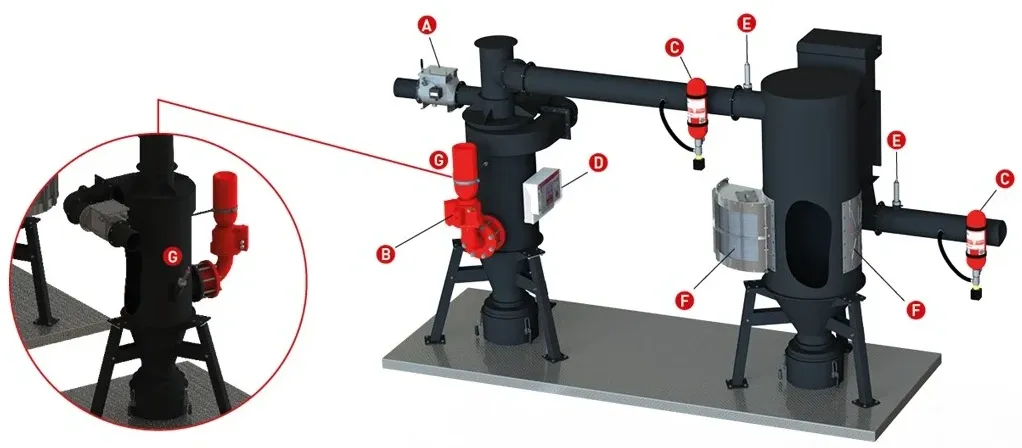
- A. Explosion Isolation Valve
- B. Chemical Tank
- C. Chemical Tank
- D. Control Unit
- E. Optical Spark Detector
- F. Flameless Evacuation Device
- G. Pressure Detector
Explosion Damping
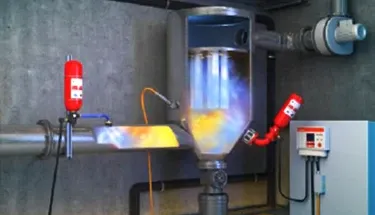
Chemical explosion suppression systems consist of control panel, chemical filled pressure tubes, pressure and spark detectors. When an ignition occurs, pressure waves are created due to the increase in temperature. The pressure expands by increasing and pressure detectors detect this pressure increase and inform the control panel. Likewise, the spark detector detects the spark source and informs the control panel. The detector is selected according to the area to be protected. Only spark or pressure detector can be selected, or both can be used. The control panel activates the scenario with the incoming information and sends a trigger signal to the explosion suppression tubes. With the discharge of the chemical suppressant into the closed space, the ignition/spark source is cooled and the pressure drop is provided.
Other equipment connected to the closed volume is isolated with active or passive explosion prevention systems to prevent the spread of fire and explosion. Enclosed space and connected equipment must be protected against possible fires.
Explosion prevention systems cannot be used as a substitute for fire extinguishing systems.
Evacuation & Isolation
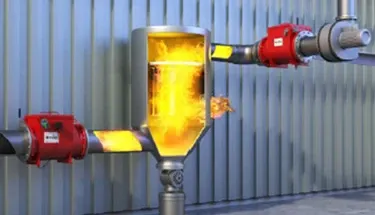
Pressure explosion relief equipment limits excess pressure and reduces damage to process equipment by relieving excess pressure to a safe area in a controlled manner. Explosion evacuation systems offer an economical, cost-effective means of explosion prevention. State-of-the-art products are offered in explosion evacuation covers and flameless evacuation (flame arrester) systems.
Explosion evacuation indicators can be installed to signal the process control system to shut down all process equipment to prevent further hazards and damage. Other equipment connected to the enclosed space is isolated with active or passive explosion prevention systems to prevent the spread of fire and explosion. During normal operation, passive isolating devices are kept open in the direction of the process flow and are closed after the pressure wave of a flash.
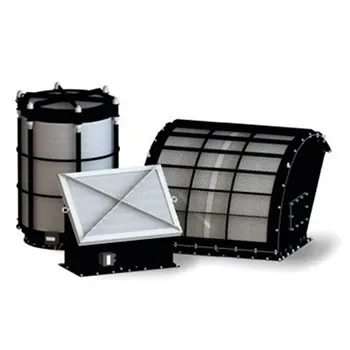
Flameless Explosion Evacuation 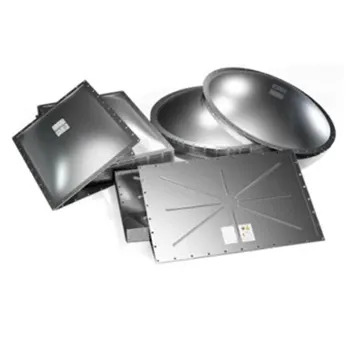
Explosion CapsRelief of Excess Pressure 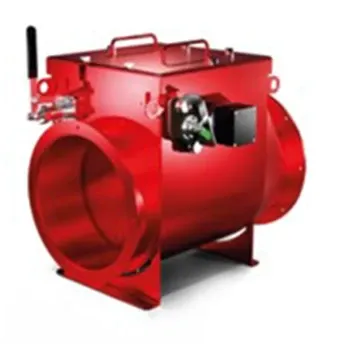
Pressure Isolation Devices
Active Isolation
Active isolation systems are fast acting systems that can stop a fire or explosion going through pipelines. The valve is used with a controller and a sensing device using pressure or IR to form an active fire and explosion protection system.
Pressure cylinders are used with a controller and a sensing device using pressure or IR to create an active fire and explosion protection system. Isolation is provided by the chemical substance forming a barrier in the pipeline.
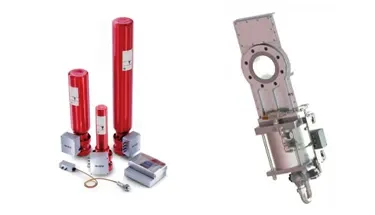
System Applications
Explosion prevention systems used in many areas such as filters, cyclones, silos, elevators, pneumatic conveying equipment and dust collectors are a very critical industrial process safety layer that prevents large-scale industrial accidents.
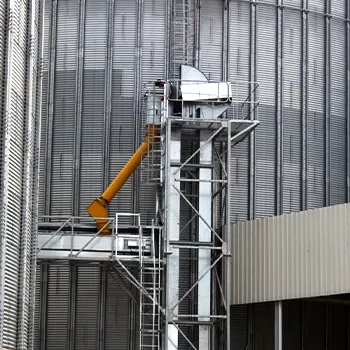
Elevator Systems 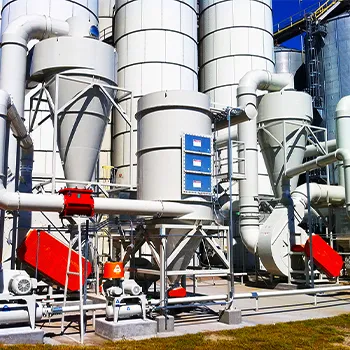
Silo FieldsTransfer and Filling Lines 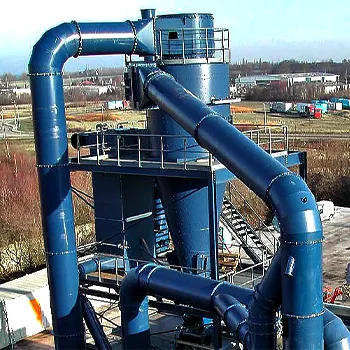
Cyclone Systems
Related Solutions
Let's Identify the Risks in Your Process
Let's determine together what precautions should be taken regarding explosion and fire safety in your facility.
