
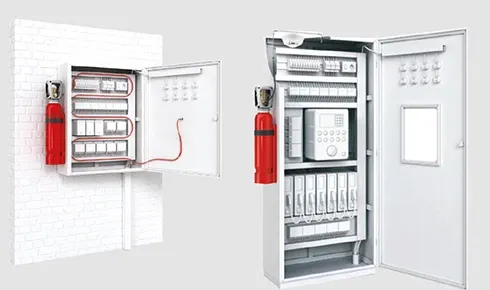
In-Cabinet Fire Suppression Systems
What Is In-Cabinet Fire Suppression?
An automatic system that detects potential fires in electrical cabinets of a defined volume (roughly 8.5 m³), around the clock and without human intervention, and suppresses them within seconds. It catches fires that might otherwise go unnoticed or unreached by manual intervention, preventing them from growing and avoiding the delay that comes with waiting for a person to respond.
In industrial applications especially, where reducing fire risk and keeping operations running without interruption matter most, a gaseous suppression strategy is generally preferred for these systems — one of the most effective ways of bringing a fire under control at the point where it starts. Depending on the nature of the fire risk, in-cabinet systems using dry chemical powder are also available.
Certificates & Approvals of the In-Cabinet Suppression Systems We Offer


In-Cabinet Suppression System Types
The choice of system is determined by the type of fuel or combustible material to be suppressed. The most efficient system is selected by also taking into account the test results of the foam concentrate to be used, the application area and the application duration.
Clean Agent
HFC-227EA / FK-5-1-12
HFC-227ea and FK-5-1-12 are the extinguishing gases preferred for clean agent suppression systems. They let you keep your facility running through a fire event with minimal damage and disruption. By chemical action, they absorb heat from the fire environment and remove the heat leg of the fire triangle.
Dry Chemical Powder
DRY CHEMICAL POWDER
These systems, which use dry chemical powder, are applied directly to the source of the fire to suppress it quickly. They are particularly effective against electrical fires, and are preferred where gaseous systems are unsuitable or too costly.
CO2
CO2 GAS
These systems suppress fire quickly using CO2 gas. The gas brings the fire under control by displacing oxygen from the space. It is widely used in electrical cabinets because it is non-conductive and does not damage equipment. It also leaves no residue, so no clean-up is required.
In-Cabinet Suppression Application Methods
In-cabinet suppression systems can be applied using two different methods, depending on site conditions and the fire scenario. These methods offer flexible detection and a range of suppression options.
Direct System
TUBING SYSTEM
Gas discharges through the burst point in the tubing system. Used for hard-to-reach areas and systems with a small volume.
Indirect System
DISTRIBUTION NOZZLE
Gas discharges through a separate distribution nozzle. Used for systems with a fully enclosed volume.
- Economical, easy installation
- An effective solution for units separated by multiple systems
- Wide protection area
- Enables rapid gas discharge
- Can be applied with all extinguishing gases
- Allows manual activation
In cabinets where sealing cannot be fully achieved, fire-stop rated filler materials should be used to close the openings.
If a ventilation system is present in the enclosed volume, it must be shut down before discharge begins.
Related Solutions
Let's Identify the Risks in Your Process
Let's determine together what precautions should be taken regarding explosion and fire safety in your facility.
